
Evolution libre, new chapter for a wilder France
A UNESCO-IUCN conference on évolution libre – ‘free evolution’ – was held in Paris on 12-13th February. With some 400 attending in person and online, it was convened to promote the practice of management by natural processes, unfettered by human intervention or extraction.
Although only making its debut in France within the last few years, the concept is spreading rapidly, and the agenda included an international round table facilitated by Wild Europe with input from Germany, Poland, Switzerland and Canada.
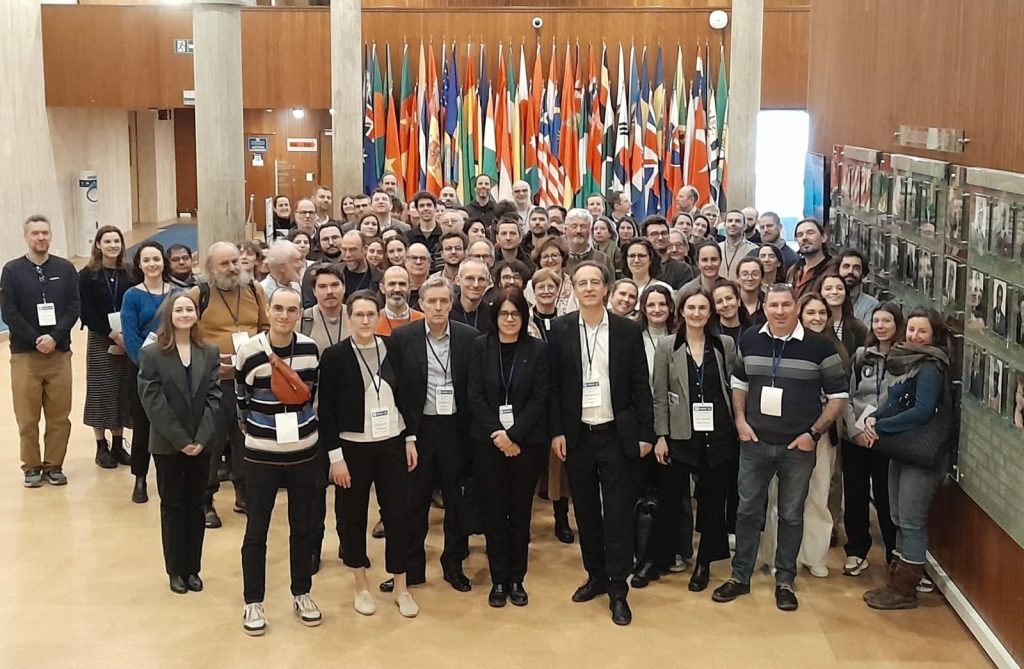
The conference was led jointly by UNESCO and IUCN representatives, including (from centre to right in photo) Maud Lelievre, President IUCN French Committee; Franck Pupunat, Advisor to UNESCO French Commission; Pascal Cavallin, Chair of GT on Wild Nature IUCN France and Laure Germain-Thomas, Manager for Protected Areas and Naturalité IUCN France.
It sought to establish a conceptual basis for the libre évolution movement. This involves progressive stages of ‘rewilding’ from restoration of bare, often economically marginal, agricultural land and former commercial forests to protection of nearly intact existing ecosystems – working towards a state of ‘free evolution’ by maximising the naturalness of an area. It is in effect another way of describing the practice and impact of non-intervention, with benefits for address of climate change, biodiversity recovery and socio-economic betterment.
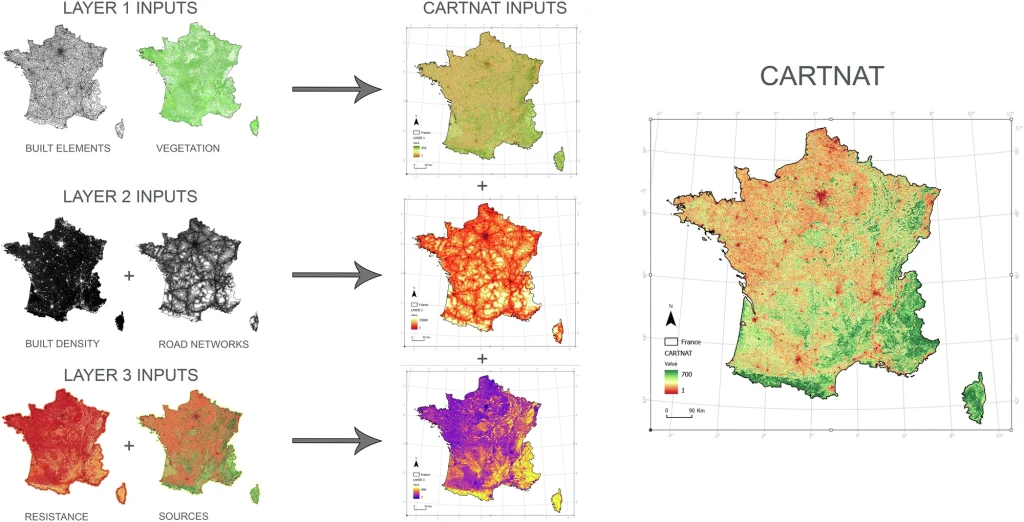
An initiative to identify current and potential sites was discussed, assisted by a CartNat project to map naturalness across France led by Adrien Guetté (University of Tours) and Jonathan Carruthers-Jones (University of Helsinki) with Steve Carver (WRI). This was accompanied by assessments of policy reforms, legal instruments and financial sourcing needed to further support the concept.
Wild Europe, through Toby Aykroyd, facilitated an international dimension with a Round Table providing presentations of wilding initiatives by a distinguished range of conservation leaders:
Sebastian Brackhane: Policy Advisor, mandated by German Federal Ministry for the Environment;
Bogdan Jaroszewicz: Director of the Białowieża Geobotanical Station, University of Warsaw, and Deputy Director General, Polish State Forests (nature conservation & environmental education)
Monique Poulin: Professor at the Department of Phytology, Université de Laval (Quebec)
Isabelle Roth: Deputy Managing Director and Head of Natural Forests, Zurich Wilderness Park
A valuable impetus for conservation
An overall aim of the programme involves integration of libre évolution into the French National Biodiversity Strategy, based around a promising liaison between UNESCO France, IUCN France, the Coordination Libre Evolution network, and Reserves Naturelles de France for whom Wild Europe provided a presentation introducing libre évolution and conservation at their 40th anniversary conference in 2022.
Operating within the framework of the Kunming-Montreal agreement and the EU Biodiversity and Forest Strategies, France’s ambitious conservation aims include protecting 30% of terrestrial & marine habitats and restoring 30% of those which are degraded by 2030.
Libre évolution, with its cost-effective management at scale by natural processes, and provision of funding through the payment for ecosystem services agenda, has much to offer this agenda. The UNESCO-IUCN conference provided a valuable impetus – in France and across Europe.
Further reading: Proceedings for the two day conference: chaîne YouTube du Comité français de l’UICN: Journées de la Libre évolution 2026 – UNESCO. (See international Round Table at 1:16:33 in mixed French & English).